Thursday, 30 August 2012

Top Wedding Tips

When choosing your wedding dress and flowers you might like to think about the colours that will suit your complexion.  Those with a sallow complexion suit stronger, blue –based colours and pure white rather than ivory, whilst red heads should avoid white and choose ivory or cream instead.  Red is a colour that suits every complexion so it is always  suitable and really warms up a Winter wedding.  
this bride will certainly stand out but for the right reasons!

Tuesday, 14 August 2012

The Sunflower

Helen Keller - "Keep your face to the sunshine and you cannot see the shadow. It's what sunflowers do."

    Sunflowers are annual plants that are native to the Americas. Their stems can grow to more than 10 feet high, and their flower heads can reach nearly 12 inches in diameter. The scientific name for sunflowers is Helianthus annus. More than sixty different varieties of sunflowers can be found around the world. Out of these, the most common one is bright yellow in colour, with a dark brown centre filled with seeds. The others include those in shades of orange, red, maroon and tan. Some varieties also have striped petals.
The head of the sunflower is not one flower; it is a head that contains many small flowers that are packed together tightly. The outer florets on the head, called ray florets, can be orange, maroon, yellow, or other colours. The florets inside the head are called disc florets. Many people call the disc florets sunflower seeds, though they are truly not seeds but the plant's fruit.
The first evidence of domestication of the sunflower as a crop comes from the region called Mesoamerica, as early as 2600 B.C. It has been found that the natives of this region consumed the seeds of the sunflower plant as they were rich in calcium. The first European recorded to encounter the sunflower is Francisco Pizarro when he travelled to Peru. The Incas, the Otomi and Aztecs used the flower as the symbol of their sun god. By the 16th century, sunflower seeds were being shipped into Europe, as well as gold figurines of the flower. Sunflower oil became popular during the 18th century, especially among the Russian Orthodox Church, because it was a type of oil that was not prohibited from being used during Lent.                                                                
Commercial planters plant the seeds 1.5 feet apart and to a depth of one inch. Sunflowers grow best in full sun in well-drained soil rich with organic matter such as mulch. Home growers can plant them as they wish, either as individual plants or in groups.
    Sunflowers have always fascinated the creative minds throughout the world. We have all sorts of poetry, prose, paintings, and the like, which depict and describe the sunflower in numerous different ways. The famous Dutch painter Van Gogh was so amazed by its beauty that he created two series of paintings depicting sunflowers in various contexts. Such is the magic of this wonderful creation of God, that whoever sees it once, simply falls in love with it.


Saturday, 31 March 2012

Rhizanthella Gardneri- The Underground Orchid


There are over 25 thousands species of orchids in the world; however Rhizanthella gardneri is especially unusual. This critically endangered orchid found only in Western Australia, spends its entire growth cycle underground. Even when it flowers the blooms are several centimetres below the soil's surface.


Interestingly the orchid has only been discovered in 1928 in Western Australia by Jack Trott while he was examining a strange crack in the garden's soil and noticed a sweet smell coming from the gap in the ground. He found a small white flower which happened to be a completely new type of orchid. 


At the beginning of the rain season in autumn, the plant blooms producing a flower structure similar to a tulip. This flower head measures 2.5 to 3 cm and never emerges above ground, it only revolves the soil above it as it grows. The flower head contains up to 90 small dark red flowers. As the soil cracks appear a scent is released and spread nearby attracting flies and other small insects. Strangely, it is the first only known case of a plant that uses termites as pollinator agents.


Growing completely underneath the surface means that Rhizanthella gardneri doesn’t need sunlight and instead the orchid has evolved a parasitic relationship with the fungus and the Australian broom bush. The Fungus named "Thanatephorus gardneri" provides the orchid with mineral nutrients and sugars, while water comes from the bush named "Melaleuca uncinata"; with these ingredients the orchid creates its own food. However it is still unknown to many scientists why the orchid still has chloroplasts, cells used in photosynthesis. It has the fewest chloroplast genes found in any plant, and they are genes that are not involved in photosynthesis.


 T
he Rhizanthella gardneri is extremely rare; there are only fifty known plants in the wild, in five secret locations in Western Australia. The orchids are even difficult for informed scientists to find. It often takes hours of searching under shrubs to find just one underground bloom. It is widely agreed that rapid development of agriculture and droughts are the main causes if the reduced population of Rhizanthella gardneri. 


Tuesday, 7 February 2012

Monday, 31 October 2011

Happy Halloween!

Happy Halloween from Elizabeth Marsh Floral Design!!!!


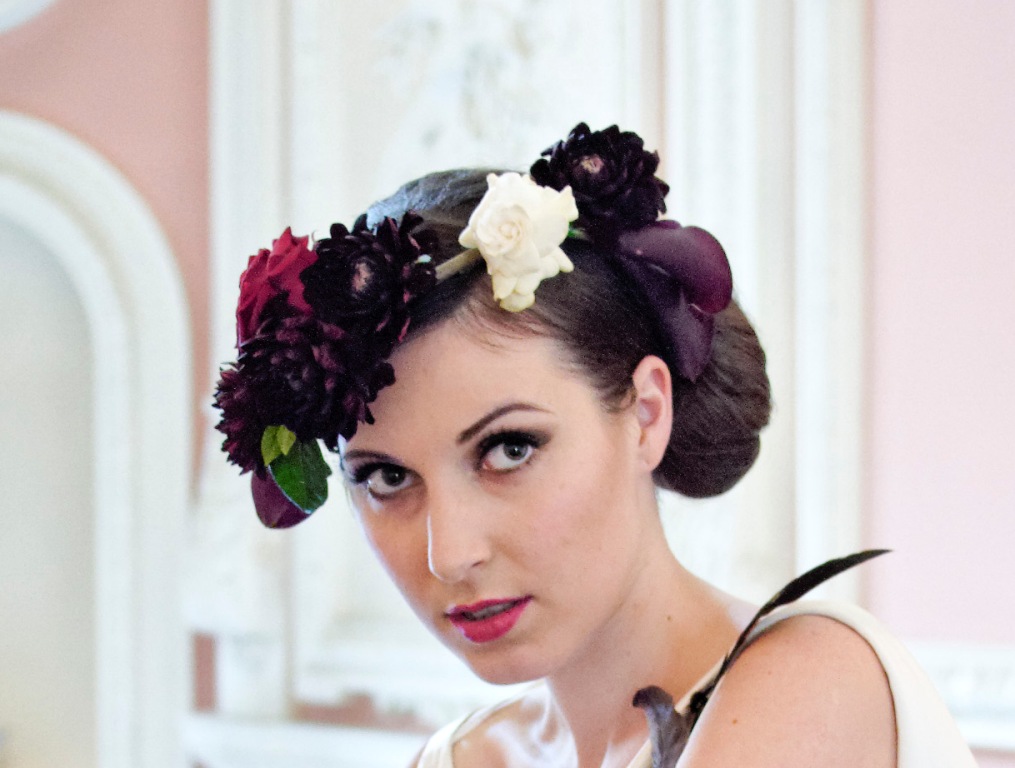
Elizabeth Marsh floral design has been getting into the spirit of things!

Femme fatales of the 1940's film Noir era have been our inspiration for this hallowed eve: dark, mysterious and sultry.

The psychological thriller ‘Black swan’ also influenced the theme - pure femininity with a dark and Gothic side..... perfect for a chic and stylish Halloween concept.


1940's inspired flowers, such as gardenias and black dahlias alongside deep red Grand Prix roses and black arum lilies evoke the femme fatale, for a sultry and ‘vampish’ look.
The white satin dress contrasts fabulously with the dark, moody flower choices – drawing us into the theme of the duality of the innocent white swan and the troubled alter ego of the black swan. The simple, pure perfection of the dress is more noticeable against the vintage style head dress with dark coloured flowers and feathers.

So let’s all get vamped up this Halloween, apply your dark burgundy lipstick, smoky eyes and fabulous floral headpiece for a show stopping Halloween party look!

Happy Halloween!!!!!!!


Styling
Dress: Ritva Westenius,
Hair styling:
Make up styling:
Venue
Model: Natalia Zawadzka 07592 899 566
: Dartmouth House, www.leithsat.com/Venues/Dartmouth+House
Lucy Oldham lucy@blushairbrushing.com
www.ritvawestenius.com Shari Rendle, www.sharirendle.com
: Cranberry Blue Weddings & Events, www.cranberryblueweddings.co.uk

Wednesday, 13 July 2011

Delphinium Flowers


The name of the delphinium flower is derived from the Latin word for dolphin; this is due to the long, sleek appearance of the unopened flower. Delphiniums are a genus of around 300 species in the ranunculaceae family. Delphiniums thrive in regions with relatively cool and moist summers, and often struggle in hot, dry summer weather. However, some new varieties are more tolerant of heat .The plants bloom in late spring to early summer, and the flowers are suitable for cutting. These flower stems grow from 4 inches to roughly 7 feet in height. Blossoms traditionally come in bright, creamy white, dainty pink, and a marvelous purple blue combination; however, some of the highbred flowers can be seen in shocking reds, oranges and yellows. Delphinium is a stately, elegant perennial that is a standard in English cottage gardens. Mounds of dark green, glossy foliage are adorned with huge spikes of showy, spurred flowers in early summer. Another common name is larkspur, although this name usually refers to annual varieties. The delphinium flower has an interesting story in real life. During the early 20th century Frank Reinelt – who was once the head gardener for the Romanian Queen, Marie – relocated to the United States and started his own nursery. In his gardens he began hybridizing delphiniums, and by the 1930s he had fathered one of the more popular breeds, the Pacific Giant.
When we consumed flowers in large quantities , can be poisonous, many still feel that they have some very potent medicinal uses. The most commonly used flower is the delphinium staphisagria, which is thought to be helpful in curing diseases or irritations of the reproductive system, as well as aiding in mental and acute respiratory ailments. These flowers may also be used to repel pests such as lice, and are thought to have a curative effect on scorpion stings.
The delphinium flower is said to represent big-heartedness and the essence of divine qualities. They are also meant to symbolize levity, fun and a general sense of joy. As a gift, these flowers can brighten up any arrangement, be it fresh or dried.


Planting Instructions

Plant in spring, spacing plants 1 to 3 feet apart, depending on the variety. Prepare the garden bed by using a garden fork or tiller to loosen the soil to a depth of 12 to 15 inches, then mix in a 2- to 4-inch layer of compost. Dig a hole twice the diameter of the pot the plant is in. Carefully remove the plant from its container and place it in the hole so the top of the root ball is level with the soil surface. Carefully fill in around the root ball and firm the soil gently.


Care

Apply a thin layer of compost each spring, followed by a 2-inch layer of mulch to retain moisture and control weeds. Water plants during the summer if rainfall is less than 1 inch per week. Soil should never dry out. Stake tall varieties to prevent hollow flower stalks from snapping in the wind. After the first killing frost, cut stems back to an inch or two above soil line. Divide plants every three to four years as new growth begins in the spring, lifting plants
and dividing them into clumps.
Colored in the shades of sky blue and white snow delphinium has redefined the very
sensation of being in love, the very feeling of warmth and affection since ages.


Delphiniums bring a wonderful touch of color to weddings. They are available in sky blue right through to rich dark blue varieties. Their height makes them particularly good for tall table center arrangements, and for ceremony arrangement pedestal stands.
They can also be cut to make smaller arrangements and bouquets. The bridal bouquet in the photo below features dark blue delphiniums in a collar around white roses.


Friday, 25 March 2011

Orchids


 Cattelya Orchid and Three Brazilian Hummingbirds 1871 By Heade,
  
"You can get off alcohol, drugs, women, food and cars, but once you're hooked on orchids you're finished"
Joe Kunisch.


 The orchid family is called Orchidaceae and is the second largest family of flowering plants with about 20,000 different species.  Tropical species were introduced in the 19th century and  horticulturists have been able to produce over 100,000 hybrids and cultivars,  often creating a much stronger plant, so mixing and matching is a very positive thing.

Most orchids are found in the tropics, Asia, Central America and south America.
In Europe you can find the pyramidal orchid which you can see below.


 In south Africa  disa orchids are found which are loved for their beautiful bright colors, which is pictured below.


 Orchids have become very popular over recent years, mainly because of their beautiful blooms but also because they are easy to look after.  Orchids must be planted in either bark or sphagnum moss so that the roots are surrounded by material that lets them breath.  They should be placed in an area where their is lots of light  with some shade because their natural habitat is tropical therefore they thrive in temperatures between 55ºF and 80ºF.  Orchids should be watered every 5 to 10 days, but over watering can be deadly!

Different species of orchid flowers bloom differently.  One type of orchid may bloom only once a year and another may bloom several times a year.  Some also have a continuous bloom all lasting for different lengths of time depending on the species. 

Orchids have simple leaves with parallel veins which vary in size.  The leaf type depends on the orchids habitat.  In dry sunny areas the leaves are often thick and leathery and covered by a waxy cuticle to retain water.  Orchids which enjoy the shade have long thin leaves.  The leaves of most orchids live for several years making them perennial but some others shed their leaves yearly to grow new leaves.

The most popular orchid for interior spaces is the Phalaenopsis orchid.  They are easy to grow and produce beautiful blooms that can last 2-3 months.  While a Cattleya orchid plant will last only up to a month after the bud opens.

 A Phalaenopsis Orchid


A Cattleya Orchid which last only a month after the bud opens.

Another favourite is the Dendrobium orchids. These orchids have smaller blooms and prefer warmer temperatures.  The Dendrobium orchid is one of the largest orchid species and is naturally found in places like new Guinea, Thailand, Southern China, Australia, and New Zealand.

 A dendrobium orchid

Some types of orchids also have a fabulous fragrance, for example some types of cymbidium orchid, which is another reason for the orchids popularity.

Cymbidium orchids


Here are a few other facts about orchids.

  • Orchids were the 'must have' accessory of the 1800's.

  • The largest amount ever paid for a new orchid species in 1890 was £1500 which  today is equivalent to £96,500!

  • About 200 to 300 new orchid species are still being discovered each year.

  • There may be around 5000 species which haven't been described.

This is just a small insight into the orchid and its family.  New species are forever being grown and discovered,  creating an excitement and fascination around the orchid family, making them one of the most popular plant to be enjoyed by everyone today.